Second Sunday after Trinity by Rev’d Lucy
Genesis 18:1-15, Romans 5:1-8, Matthew 9:35 – 10:8
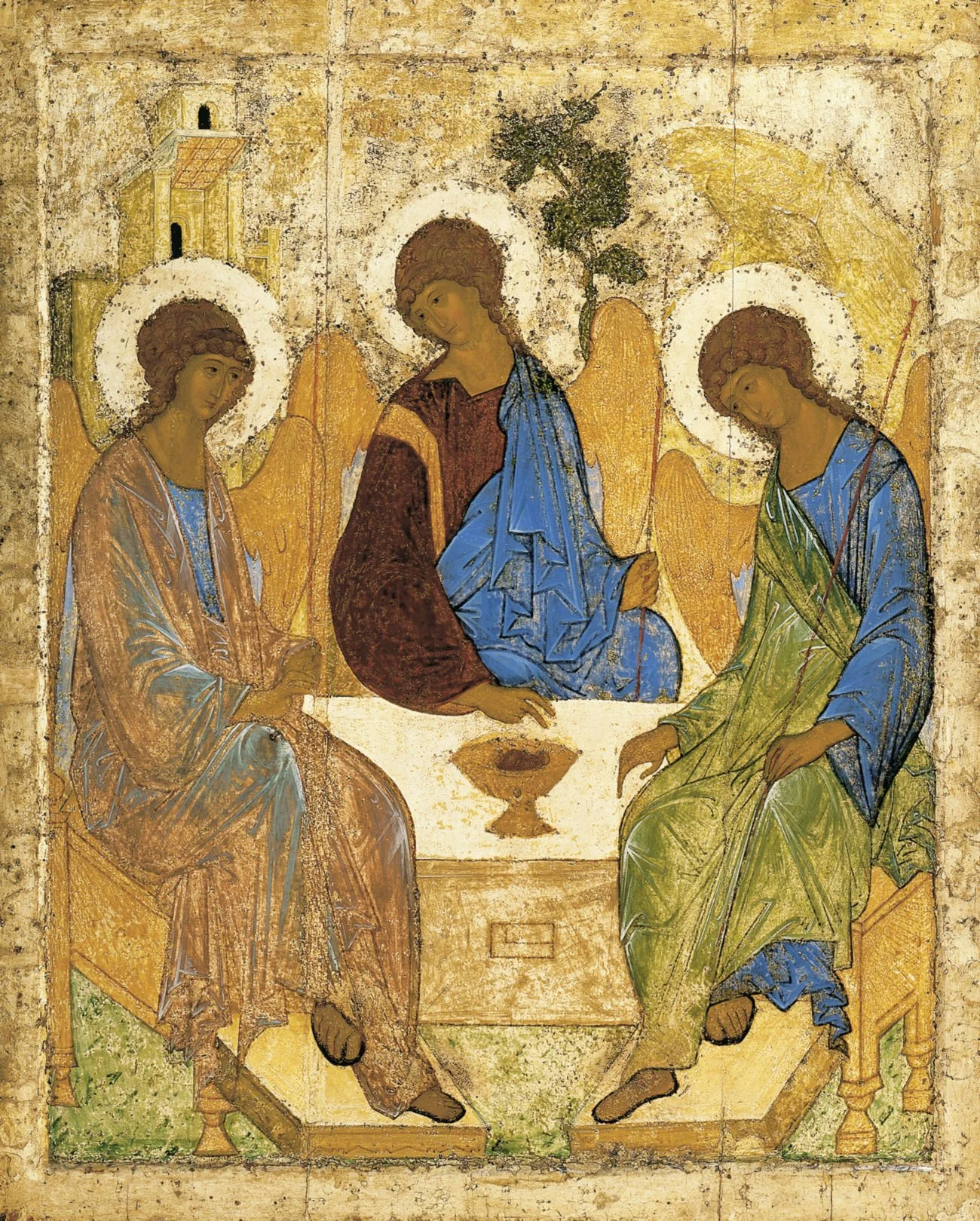
This morning’s first reading takes us out to the oaks of Mamre, to Abraham, sitting at the door of his tent in the heat of the day. Three strangers appear. He runs to meet them, bows to the ground, hurries Sarah to her baking and a servant to the calf, and waits on them himself while they eat. And somewhere in that meal he’s handed a promise so unlikely that Sarah, listening behind the tent door, laughs out loud.
It is one of the strangest scenes in Genesis, and it became one of the best-loved images in all of Christian art. Six hundred years ago the Russian monk Andrei Rublev painted it, and the icon he made has come down to us with two names. One looks at Abraham, and calls it The Hospitality of Abraham. The other looks past him, to his three guests, and calls it, simply, The Trinity. A human welcome, and the life of God, in one picture. Hold those two names together for a moment, because the whole sermon is in them.
Let’s look at what Rublev gives us. Three figures at a table, and almost nothing else. Gone are Abraham and Sarah, the tent, the servants, the meal, all the bustle of the story. What’s left is three seated figures, a tree, a house, a hill, and one cup. The eye has nowhere else to go.
The question the picture puts to us is the same question Abraham faced at his tent door: who are these three?
Scripture itself will not quite tell us. It opens, “The LORD appeared to Abraham,” and then, in the very next breath, “he looked up and saw three men.” One moment Abraham speaks to them as one, “My lord, do not pass by your servant”; the next, they answer him together. Readers have wrestled with this for a very long time. Philo of Alexandria saw the central figure as God himself, with two great powers at his side: the power by which he creates, and the power by which he rules. The rabbis saw three angels, each on a single errand, one to promise Isaac, one to heal Abraham, one to deal with Sodom. Early Christians read it differently again. Justin Martyr saw Christ here, present in the world before his birth, with two angels beside him. And Augustine looked at the three and saw the Holy Trinity, though he would not say which figure was which. Rublev stands at the end of all that long pondering, and he gives his own answer, not in words, but in an image.
Look again at the three. They are alike, and they are equal. Their robes differ, but nothing marks one as greater than the others. They lean their heads towards one another, as if caught in the middle of listening. And Rublev has arranged them in a circle of mutual regard. The eyeline between the three figures forms a continuous movement around the table. There is no obvious beginning and no obvious end. This is something of what the Church confesses when it calls God Trinity. God is, in himself, a communion: three persons, one God, eternally turned towards one another in love.
At the very centre of the table stands a single cup. In the story Abraham set a whole feast before his guests, the calf, the curds, the cakes; Rublev reduces all of it to this one cup and sets it there like something laid on an altar. Behind the figures stands a tree. In the story it is the oak of Mamre, but it also calls to mind the wood of the cross. The God whose life is communion is the God who gives himself away. Even in this still and gentle picture, the cup of sacrifice is already on the table.
There is one more detail. The three sit at three sides of the table; the fourth, nearest us, facing out of the icon, is left open. Those who have prayed with this icon down the centuries have understood that open place to be theirs. The circle of God’s own life does not close in on itself. It makes room, and the place it makes is left open, facing out, towards whoever will come.
The place is not kept for the strong, or the worthy, or the people who have their lives in good order. Paul says it as plainly as it can be said: “While we were still weak, at the right time Christ died for the ungodly” (Romans 5.6). And again, in case we missed it: “God proves his love for us in that while we still were sinners Christ died for us” (Romans 5.8). The love comes first. It does not wait for us to be ready.
This is the same God we meet in the Gospel. Jesus goes through the towns and villages “curing every disease and every sickness,” and when he sees the crowds, “harassed and helpless, like sheep without a shepherd,” he has compassion for them (Matthew 9.35–36). Not a God who waits until we are well before he comes near, but one whose first movement, seeing us in our trouble, is compassion.
Our readings remind us that we do not have to be well to belong at this table. Some of us may be ill this morning, or tired to the bone, or carrying a grief that has not lifted, or living with a weakness that will not mend however hard we pray. The healing Christ brings is real, and it is God’s own work, and not all of it comes when or how we long for it. But the compassion is here now, it is for us, and no weakness of ours has ever put us beyond the reach of God’s love. Remember Sarah, old and past hope, who laughed, and then was afraid, and said she had not laughed. God did not hold her weakness against her. The promise simply stood: “Is anything too wonderful for the LORD?” (Genesis 18.14).
So the strength we need is not something we have to pull out of ourselves. “God’s love has been poured into our hearts,” Paul says, “through the Holy Spirit that has been given to us” (Romans 5.5). Poured in. Given. Not generated, not achieved, not deserved. We are not saved because we are good enough. We are saved, and healed, because God loved us first. The place at this table is for you. And it is for me.
We come to that table to be fed. But to be given a place there is also to be turned towards everyone still outside it. There’s one figure the icon leaves out altogether: Abraham. He’s missing from Rublev’s table because in the story he never sits down. He’s the host, the one on his feet, serving. Watch him in the reading. He sees three men, strangers, in the heat of the day, and he doesn’t stop to establish who they are before he serves them. He runs to meet them, kills the calf, and waits on them under the tree while they eat. The welcome came first.
In our Gospel reading, the disciples are sent to give as freely as that. Having healed, Jesus sends them out to heal in turn: “As you go, proclaim the good news, ‘The kingdom of heaven has come near’” (Matthew 10.7). “Cure the sick, raise the dead, cleanse the lepers, cast out demons” (Matthew 10.8). And he tells them on what terms: “You received without payment; give without payment” (Matthew 10.8). What they have, they were given. What they were given, they give away. There is no charge at this table, coming in or going out. We do not earn the grace, and we do not get to keep it for the people we have decided deserve it.
And there is work to be done. “The harvest is plentiful,” Jesus says, “but the labourers are few” (Matthew 9.37). So, look at who he sends. Matthew the tax collector, a man who had gathered Rome’s money from his own people, a byword for sin. Peter, who will deny three times that he ever knew the Lord. Judas Iscariot, who betrayed him. James and John, who wanted the seats of honour at his right and his left. Not the finished article, but the people he chose. So if you have ever thought yourself too weak, too compromised, too ordinary to be any use to God, look again at that list. You are in good company.
The ones we are sent to are the harassed and the helpless. The sick, the grieving, the stranger at the door. The letter to the Hebrews looks straight back at Abraham’s tent and says to the Church, “Do not neglect to show hospitality to strangers, for by doing that some have entertained angels without knowing it” (Hebrews 13.2). Christians have often heard in those words an echo of Abraham’s welcome at Mamre. Every person who comes to us bears the image of God. “Truly I tell you, just as you did it to one of the least of these brothers and sisters of mine, you did it to me,” Jesus says (Matthew 25.40). The stranger may be carrying the promise, as at Mamre. The stranger may be Christ himself.
“You shall also love the stranger, for you were strangers in the land of Egypt” (Deuteronomy 10.19). Remember what it was to be the outsider, and make room. Israel carried that memory through the generations. The Church receives it as a gift.
We need to hear that now. The stranger is too easily spoken of as a threat, or a problem to be moved along. We hear the migrant, the one who crossed the water to reach us, talked about as an ‘invader’, as though arriving here were a crime. Scripture will not let us see a person so cheaply. Here is someone made in the image of God. Here is one of those least ones in whom Christ promised we would meet him. We are not asked, this morning, to settle every political question a nation must weigh, but we are asked to remember what it was to be strangers, and to love the stranger in our midst now.
In a few moments we will come to this table. We will hold out empty hands and be given bread, and the cup: the same cup that stands at the centre of Rublev’s three. We do not come because we have earned the place. We come because it was laid for us while we were still weak, while we were still sinners. We come as the strangers who were welcomed, the guests for whom room was made. And then we are sent back out through that door, to the next stranger, the next harassed and helpless one, carrying the questions Abraham’s welcome puts to us: what of God will I see in you, and how can I serve you, as God has served me?
The place is laid. It always was. Come, and be fed.